Theseus

"Nancy offers a fascinating plot of truly Fulvesian quirkiness. It combines a topologically flavored impossibility with an existential philosophical question in a unique way. I loved reading the stages of its development and exploring the different solutions." Denis Behr
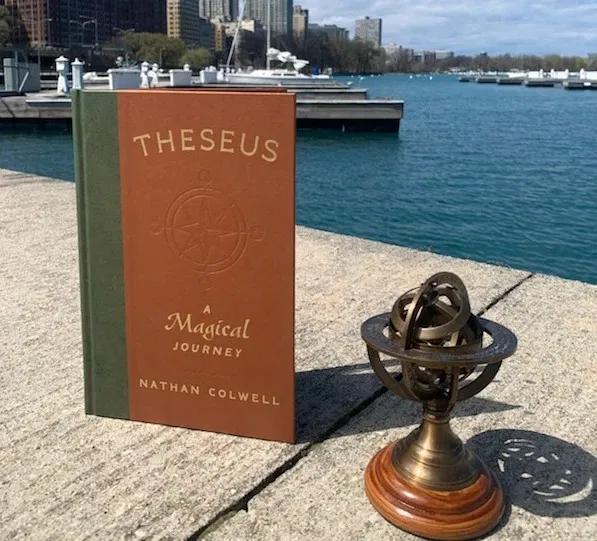
Chicago-based magician, Nancy Colwell‘s new book is themed around a card plot adapted from the thought problem “The Ship of Theseus.” Theseus addresses the age-old question: If something has each of its parts replaced, and each replacement is negligible, does its identity stay the same through this process of change? She teaches the concept, and multiple handlings in four parts:
Part I, Logbook, explains the history, general ideas, and overarching concepts which will be explored herein. This includes the Ship of Theseus thought problem, the Theseus plot, the script actively used by the author, and the history of the plot and solutions.
Part II, Open Sea, contains the methods considered fit for public consumption. They are numbered in the order originally developed; numbered versions not included are skipped. This section includes solutions Three, Five, Six, and Ten.
Part III, Adrift, contains discussions about some of the methods that did not meet the author's standards for performance. They are included to explain ideas considered necessary for a complete explanation regarding her thoughts on the plot. It also includes an interesting one-phase effect that follows Theseus’ lead-in style.
Part IV, Fellow Travelers, contains versions of the plot from two known card magicians highly respected by the author: Harapan Ong and the late Simon Aronson. Both versions are also worthy of study.
"Nancy Colwell’s Theseus is a model of how to simultaneously explain and inspire—not only its uniquely mysterious subject, but also the meticulous process of how its creative components came into being. In the ’60s such books were considered “trippy,” because they expanded one’s consciousness in evolutionary ways, revealing differences that actually make a difference. In that regard, Colwell’s debut book is both an exciting journey and a destination." Jon Racherbaumer
"I met Nancy Colwell one afternoon at Magic, Inc. and was instantly impressed by her clever ideas and flawless execution, in an unassuming style. I also sensed she was very well read and had a deep respect for the good magicians and creators of the past and present. In Theseus, I am pleased to see that Nancy is also a fine writer and analyst, with a deep conceptual thinking. Aside from the quality of the material, this book is also a master class on making choices when putting a routine together." Rafael Benatar
NOTE from the author: This book was printed two years before the author’s public transition, and so contains her deadname and inaccurate pronouns.
Customer reviews for Theseus


The embedding of the philosophical problem in the trick is very intriguing and gives the magic a really deep impressive note, reminds me of Gay Hollingworth´s "The Cassandra Quandary" or Punx´s "Kismet", impressing on another, complexer level than usual astonishments.
In now modern times I find it stimulating to combine written text, on which you can contemplate, with the clear guide of slow-motion, over-the-shoulder, close-up camerashootings of the whole sequence of the execution of the trick without tone and repetition, eventually highlighting critical moments with text or graphics like Homer Liwag´s "coin one", best explanation video I´ve every seen, or in Michael Close´s Workers series. This as an accompanying download possibility as in Eugene Burger´s "Final Secrets".