The Bullet Peek

Video download by Dustin Grimm
Price: £22.25£26.70inc VAT
Add to wishlist
Get 230 VI Points for this purchase.
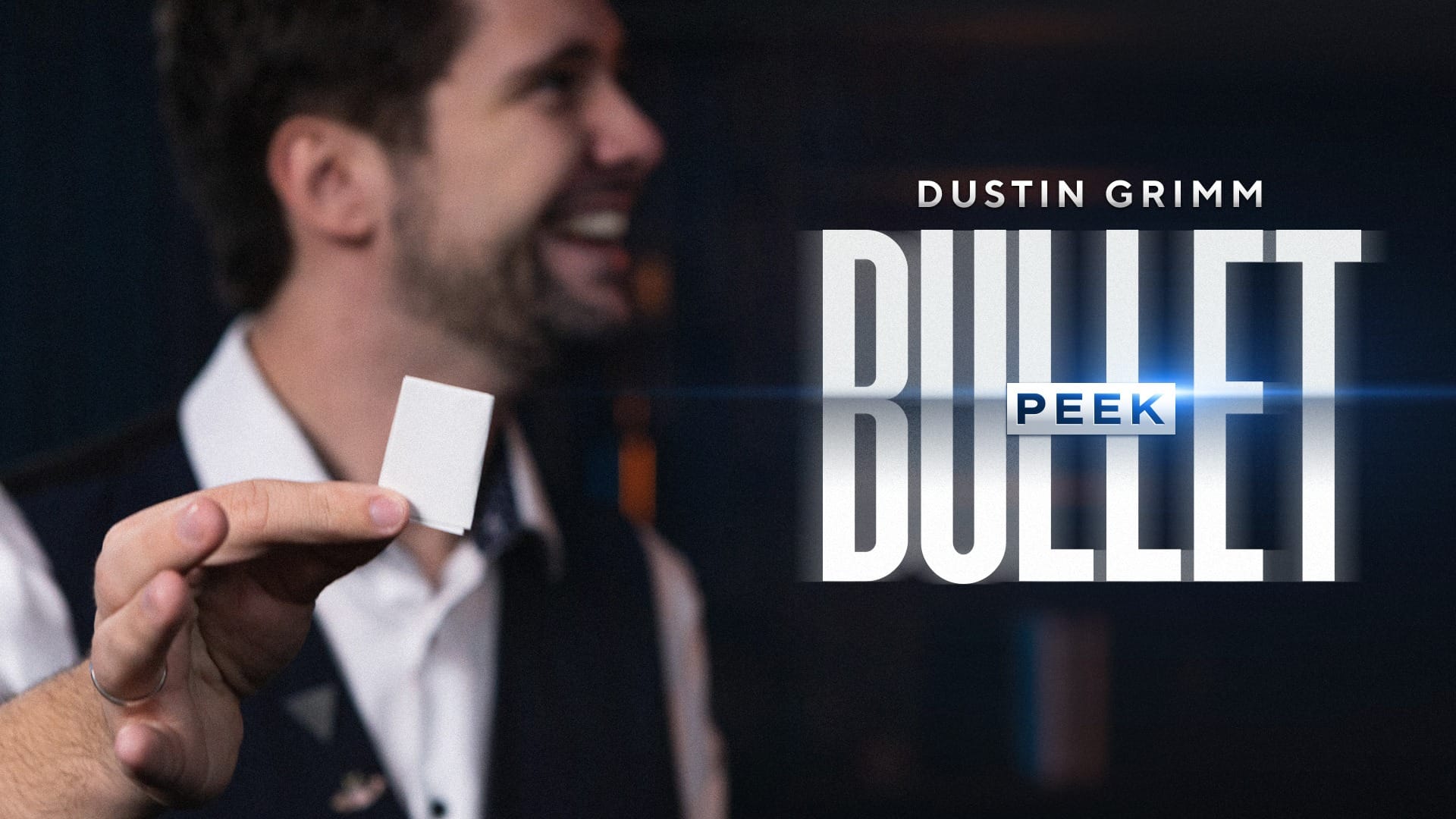
The Bullet Peek
Click to zoom

Peeking information from billets opens up amazing possibilities in magic and mentalism. You can reveal pin codes, childhood crushes, birthdates, or anything else you can think of. But for many, peeking feels inaccessible, hard to learn, or just overall too risky. But not anymore!

"The best motivated peek I've ever seen" Andi Gladwin

Introducing the Bullet Peek, by Dustin Grimm. The Bullet Peek is Dustin’s take on Millard Longman’s Acidus Novus, but with numerous key changes. It can be done in any situation, with virtually any paper, and shows you the entire bottom half of the billet, doubling the amount of information you can peek. Best of all, it is designed to be performed completely surrounded. (The angles are so good that it made it challenging to even film it from an exposed view!) If you’ve never peeked a billet, this is the perfect place to start.

This is magic and mind-reading that can be performed easily, anywhere, at any time. Never performed this sort of mental magic? No problem. Dustin shows you some killer routines to get you started. You'll learn:

  • The Gift - Reveal a thought of name. This is an emotive routine that is Dustin's signature piece.
  • Any Word - Reveal any thought of word using the premise of searching through a dictionary
  • Unlock - Unlock a spectator's phone
  • Plus ideas and tools to help you customize the routine to fit your personality and performance style

You’ll also learn multiple choreographies to cover the peek, including:

  • Wallet Peek
  • Sharpie Peek
  • Envelope peek
  • Box Peek
  • On-The-Fly Peek
  • And much more

This is so much more than just a move. This is a complete course on peek work. You’ll learn everything you’ll need to know to not just do the Bullet Peek, but to perform it confidently. This includes everything from the mechanics of the peek, to the best stationary to make it work, to the justifications and subtleties that make it invisible, to the routines that put it all together.

Even if you’ve been using billets for years, you’ll learn subtleties and techniques that you can add right away to your billet work. Dustin’s tips, choreography, and justifications can easily be adapted to any peek, and will take your mentalism to the next level.

Duration: 1 Hour and 28 Minutes

Add to wishlist

Customer reviews for The Bullet Peek

Dominik
I have just finished the video explanation of the billet peek, and I have to say I am very impressed by this in‑depth breakdown of a truly practical, simple, and deceptive technique for obtaining information from a billet. Dustin explains it precisely and in a very understandable way. He explains how to execute the peek, what to pay attention to, what to remember, and which variations can be used for different scenarios — whether in close‑up situations or even on stage. Just get it — and peek it.

(And by the way: the word you were searching for, Dustin, was “clothespin” or “clothes peg.”)
Joshua
Ultimately if you already know a similar peek: Acidus Novus, Alexander Marsh or a centre tear or Brandon Ball's gnostic oblique you are unlikely to replace them with this. But for someone who doesn't have an instant peek they may like it. This feels a bit like reinventing the wheel. It's not terrible, but it doesn't feel like an improvement on others, just a different way of achieving the same results.

The breakdown of the content:
It's one hour and twenty two minutes. The bullet peek makes up half of that taking it to 40 minutes. The rest is spent on other moves and routines. You get a one handed unfold for subtly opening a billet to read, say if you've switched in a dummy. Then there is a drawing duplication routine involving a switch and read.
The peek:
It's a variation of Millard Longman' Acidus Novus. As such it has pretty much the same advantages and disadvantages of that. It's a fairly quick peek, so if the writing is bad, your eyesight, etc you may not get the information. It is less restricted than that as the ad copy says, it's the bottom half, as the ad-copy says. I'm not exposing anything they haven't shared. It still needs justification as with other AN variations for why you are writing in that section. That is covered. I know some people dislike that restriction, some don't mind. The writing being over half the card is neither here nor there as an advantage or disadvantage. On the one hand it feels like the participant has been less restricted to where they write, but in performance most people don't see or care.

Dustin teaches it as something you can prepare in front of the participant. My gut instinct is that this is better prepared before hand. I folded a good few while watching and sometimes they didn't have the right spring. I'm sure this would improve with experience.

The initial grip is an odd unnatural grip, between middle and index finger, as others have said above. That is unless you spend your time pretending to be Audrey Hepburn playing Holly Golightly and like gesturing with a cigarette holder. But, that's not a major issue, so long as you aren't making it one. If you can carry that out as if that's how you always hold a card I don't think anyone will notice. As with all billet work, if you don't make a deal of it, they won't. The ad-copy states that it can be performed completely surrounded. This is obviously an over exaggeration. No peek can be, that said it has pretty good angles for them not seeing, but it's of limited importance as in general we're not performing surrounded. Any performer with limited experience will know how to position themselves or adjust the audience to work with the angles. I'm just a pedant who felt the need to correct that ad copy statement.

The other content:
The one handed opening is a nice way of doing it. Not particularly difficult. I probably won't use as I favour routines where I switch and peek and I can openly look at the participants card.
The drawing duplication routine is a nice routine. It makes use of a simple switch and has straight forward clean up. The drawing duplication doesn't make use of the bullet peek. It's a nice switch and peek choreography giving you a full peek that you have more time to look at. It's similar to many other switch and peeks, but it's a nice addition to add value beyond the bullet peek.

Overall:
I probably won't use the bullet peek, but I will state that I don't massively like Acidus Novus. I think most people signal the peek with it and most variants, though not many will acknowledge this to themselves. I know I do, which is probably magician's guilt, but for me, I prefer a switch and peek to get a full peek. This pretty much has the same advantages and disadvantages of Acidus Novus, so if you like that you may like this. If you don't like it, you are unlikely to find anything to change that here.

I did like the unfolding move and the drawing duplication taught. Dustin's full of enthusiasm and talks through variants. He talks through credits which is a novelty in video releases where most performers seem to be be trying to show themselves as creative geniuses or else the credits are skipped for time. The teaching is good. I could see what was going on. It took a good few replays of the peek explanation to get it orientated and in the right place, but that's all fine. The ad-copy is fairly accurate apart from the fully surrounded comment that I've already discussed. The other two comments I'd question are that it's a good place for beginners to start. I would dispute this as most instant peeks are not great places for people to start as they require misdirection, some dexterity learning the move and more importantly not signalling the move. When starting out, you have plenty to deal with, remembering the moves, your presentation, so I would say a simpler peek or full peek would be a better starting point. The other statement I'd dispute from the ad-copy is "this is a complete course on billet work". It's not, none are. But that's VI claims, not necessarily Dustin. The best billet course, for me, has been Julien Losa's billets for the modern mind reader and I know full well Julien would acknowledge that there is always more to learn.

I think Dustin's bullet peek is enjoyable for billet junkies (like me). At the current reduced price of £16 it's ok. At £25 less value. I found him likeable and enthusiastic. The teaching is clear. The move is a bit unnatural. I liked the parts that weren't about the bullet peek more than the bullet peek. I don't regret buying it, though I doubt I'll use the bullet peek, I will probably use tips within it.
Alex
I'm not terribly keen on the peek taught, but the video is packed with great information, the peek is fun to practice and obviously works, the price is good, and I'd happily buy again or buy the next thing Dustin puts out.
If you're new to billet stuff, I'd recommend spending an extra fiver or whatever to get the Acidus Novus download from VI as well, it's a simpler, arguably better peek (personal preference) and everything in this video can be applied to it as well.

More billet stuff please VI, and more from Dustin!
Steve
This is my first time learning a billet peek using just slight of hand without a magic prop. The method is really great. The only challenge I have is that Dustin is left handed (which is only 10 percent of the population), and he doesn't teach the fold for right handed people as he mentioned he would in the tutorial. I think that this was just an oversight. I had to watch that section many times to pick up on how to fold the billet. Maybe a section can be added for righties to make it quicker and easier to learn the fold and to assure them that they are doing it correctly. I will definitely be using this method with a manilla envelope and an empty playing card box.
Seung
Update: I agree with the other reviewers on this being not really for beginners because peeks do require some prior background in mentalism and billets. On Joshua’s point of the move being a bit unnatural, I would say it depends. I agree with him to a certain extent. The move is meant to be done under a “cover”/ "choreography" and does look unnatural just by itself. And yes, I also agree that we’ve moved from the old school mentalism of delayed peeks to technical peeks that allow “real time” peeks during heat. Both have their places but stealing a delayed peek seems to be a lost skill. I still think for the price it’s a solid value. Regarding the whole left hand right hand, it would have been helpful but just ended up using the left. Not a big deal as both hands are involved. Full disclosure, I got this on the release sale for about 20 dollars and would have passed it up otherwise. Here are the video contents: 1. An hour and half video on the peek, covers, justification, one handed opening, and couple of switches. 2. Three full performance videos. The primary content of the explanation video is the peek and the various covers. I do wish the download also included a PDF references/bibliography section of the other switches and peek work referenced by Dustin in the videos. I do like how Dustin calls the moves "choreographies" and the explanations are very thorough with multiple angles. Here are my thoughts on the ad copy. Various variations of Acidus Novus by Millard Longman have been used by countless mentalists since its invention. I’ve used various wallets (ex. Orphic), envelopes (ex. Bob Cassidy’s White Dwarf), and even various impression devices (ex. Psypher) before coming back to billets. Why? Because billets are the historical and technical bread and butter of mentalism. People forget the history of mentalism (a great starting point is Bob Cassidy’s ebook Fundamentals) and how important billets are to an act; whether you are talking with the spirits or convincing people of the scientific body reading explanation, or whatever presentation is popular nowadays. So despite all of this and decades of reading peeks (I recommend Richard Busch’s Peek Performances), I come back to the Acidus Novus by Longman. Why? 1. Any stock business card. 2. Cheap 3. Angles. You can peek with the billet in plain view. This is the most important because you can choose when to peek. Although the ad copy states for beginners, I disagree. You can certainly do this if you are a beginner but I recommend reading some classic literature on billets before i.e. the good ol cheap copy of Annemann’s Practical Mental Effects. I believe Alexander Marsh also has a video on billet work along with Peter Turner’s booklet and I also recommend Bob Cassidy’s work on billets. The other review mentions the Acidus video here. Technically the download is "ESPidus Novus" by Jason Suran which does discuss the peek in detail but much more. Penguin does have a video on just the Acidus for 5 dollars, however. I have both. Now it comes down to this: will this supplant the Longman Acidus? Depends. Mechanically, the billet preparation is the same, but the angles and the window are vastly different. It’s true Dustin’s does allow for a full bottom peek. But the angles are different. Is it better or worse? I think it’s more complicated. So there’s the trade off for more window. But yes I will practice this move because it would give me the option of doing the traditional Acidus or Dustin’s depending on what I need to peek. And the angles are indeed good as the ad copy states, but under the right “cover” that’s really not a cover and nobody will think you are covering the billet because to them it’s in clear plain view. An unequivocable value for the information clearly taught.
Kris
It's a good peek. Easy to set up. Covers a good portion of card. Dustin is a wonderful teacher. He teaches with joy and insight. He covers the mechanics thoroughly. I really enjoyed his insights into motivating the peek. It makes for a very casual handling. There are many peeks I've learned that I never use but I am absolutely using this one.
Kristijan
Dustin is an amazing performer and instructor, and I love what he's achieved with the Bullet Peek here, great work and thinking!

Not only are the explanations clear and simple, but there are also multiple routines provided that you can instantly go out and perform. I haven't used billet peeks much, but maybe the time has come :)

Once again, great work Dustin! Looking forward to more of your projects in the future! :)
Emil
The techniques taught in this download are amazing.
If you want to know why: Dustin is an outstanding card and coin magician. He knows very well how to perform slights and also how to teach them.
He has an very deep understanding of how to make things deceptive. Not only on a technical side, but also a psychological one.
My personal highlight is the absolutely FLAWLESS constructed drawing douplication.
This is something that Darwin Ortiz could have dissected over 5 pages in his book "Designing Miracles".
It's that good!
You'll get amazing techniques, super clever covers (both visual and psychological at the same time) and very fun premises for routines (that don't rely on pretending to read body language).
Top Noch!
I really hope there will be more projekts with Dustin!
Michael
This is a good peek, but just know that if you’re right handed this is going to take a fair amount of work to watch the video and frequently stop to mentally reverse everything…because Dustin is left handed…and you will have to make adjustments because not everyone has the same hand size…so the moves work great in his hands because of his hand size but for many of us might not. Is this suitable for beginners? No, because peeks aren’t beginner material and require some experience before you can do peeks and not expose the method. If you’re experienced with billets you may like this more than your current preferred method and you’ll maybe pick up some interesting tips. Is it worth the price? Well as a professional, spending money on learning material is part of the game so I just look at the cost as my ongoing tuition. In this case I didn’t regret the purchase.
Phelyx
A practical and functional alternative, and better for the stage than most. Brilliant as a stand-alone, but best when added to other methods; center-tear, A.N... Multiple methods destroy attempts to back-engineer.
Mingche
a solid, workhorse billet peek that can be applied in multiple context (as long as you can justify writing something down).

Community questions about The Bullet Peek

Have a question about this product? It's possible others do too. Ask here and other Vanishing Inc. Magic customers will be able to respond with assistance! Alternatively, email us and we can help too.

  • Steve asks: Will you add a tutorial for right handed people. This would greatly help!

    • 1. Jim responds:Certainly worth considering.
  • Andrea asks: What are the differences from the Marsh peek teached by Alexander Marsh?

    • 1. Dustin (creator) responds:Hey there! The main difference is that my peek allows you to access the entire bottom half of the billet. With Alexanders Peek (which is fantastic by the way), you need them to write into one corner, like with the traditional acidus novus. I also teach some choreographies for the peek that can also be used with Alexanders!
  • Seung asks: Hi! How long is the video? There are usually duration length in the description but couldn't find it for this product. Thanks!

    • 1. Dustin (creator) responds:I'm sure the exact time will be posted later, but it's around an hour if I'm not mistaken :)
  • John asks: What is the degree of difficulting in performing this?

    • 1. Dustin (creator) responds:Depending on how much experience you have with billet work, this will either be very intuitive or you will need a few days to get used to the move. The motion itself is not hard, so after a short time you will be able to use it!

4 questions