Two Eds are Better Than One: Volume Six
By Ed Hass -
The Flexible Count
When I restarted my interest in magic in the late 1970s, I was lucky to see a lecture by the magician Jose de la Torre. Part of the lecture was on "Weird Counts." He was referring to magicians who did false counts in unnatural manners that tipped off that something was going on.
This hit home, because a short time before, I performed "Twisting the Aces" for a coworker, and his response was, "I don't know how you did that, but I think you were doing something when you counted the cards."
He was certainly right about that. I don't know if it was Vernon or Ganson, but in More Inner Secrets of Card Magic, the Elmsley Count was taught holding the packet at the fingertips of both hands. I thought this was odd, but who was I to contradict Vernon?
De la Torre's premise was that you should do false counts the same way you would normally count cards. Start with the packet of cards in dealing position, push off the top card(s) toward the taking hand, and take it between the fingers and thumb of the taking hand. I bought de la Torre's book, Real Magic, studied his methods, and have used them ever since.
I don't understand why so many magicians today deal cards from left to right, but do all of their false counts from right to left.
What does this have to do with Marlo's Magazine? On page 77 of Volume 3, Marlo teaches his "Flexible Count." We are about to learn how to count four kings, alternately face-up and face-down, as four face-up kings with three face-down cards between them. Marlo points out that we are going to start with the cards in Mechanic's Grip in the left hand.
Marlo instructs us to start the count by using our left thumb to pull the top card of the packet to the left. Simultaneously, your right hand, holding the right side of the packet, moves the remaining three cards to the right, as you count, "One."
What? You're counting from your left hand into your left hand? No one does this; it adds confusion. It is the point the spectator will remember that you did something contrary to what you were trying to prove.
After this odd start, Marlo has the cards in his right hand, at the fingertips. He deals the rest of the cards into his left hand Mechanic's Grip. On the count of "Four," he interposes his right little finger between the single card in his right hand, so that the three cards in the left hand can be switched for the card in the right hand and counted back into the left hand on the counts of "Five, Six and Seven."
Why doesn't Marlo just have the cards start in the right hand fingertip grip and deal the first card into the left hand just like all the rest?
Better still, why not start from the left hand fingertip grip and deal from the left to the right, as is the most common?
And finally, with a small change in technique, you can deceptively count the four cards as seven starting in Mechanic's Grip in your left hand, dealing into fingertip grip in your right — the way people would normally count the cards.
Here's how. Let's say the first and third cards are the face-up King of Clubs and the face-up King of Hearts, in Mechanic's Grip in your left hand. The other two kings are face down. You will count these four cards as seven, emphasizing the face-down cards as you say, "We have four face-up Kings, and One, Two, Three, face-down cards."
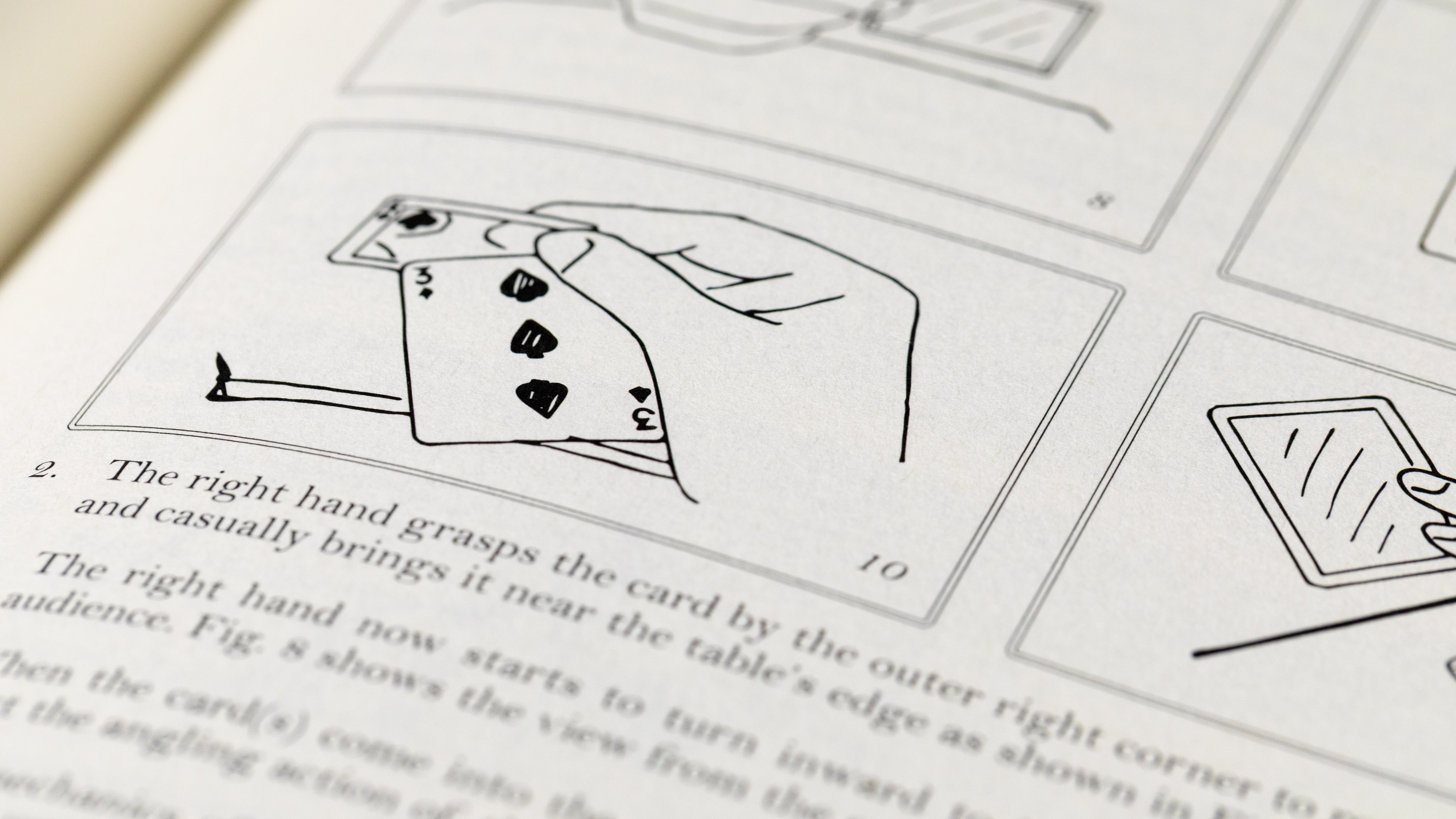
Your actions will be as follows: As you say, "We have four face-up Kings …," your left thumb pushes the top card to the right as your right hand grasps the King of Clubs near the lower right corner, your right thumb covering the large club pip, and your right first and second fingers below. The right hand draws the card diagonally across the card beneath, so the upper left corner of the card snaps off the lower right corner of the card beneath it. As you say the word "One," your right hand moves back under the cards in the left hand as the left hand thumb pushes over the next card, which is taken into the right hand.
Immediately after the face-down card is taken, the right hand moves back, and the King of Hearts is taken. You do not speak as this happens.
As you say the word "Two," counting the second face-down card, you do the following: The three cards in your right hand are placed directly under the single card in your left hand. Your left thumb pushes the top card off to the right as your right hand takes this card into the right hand and then goes back to take the King of Hearts. As you say the word "Three," the right hand takes the final face-down card and then the King of Clubs as you finish the sentence.
I suggest that as you say the word "One," you look down at the cards to focus attention on them after you've counted off the King of Clubs. When you say the word "Three," look up at the spectators, so they are less likely to notice the King of Clubs has shown twice.
As you can see, with a little thought, you can convert "weird" counts to "normal" counts.
Marlo's Downjog Separation
This is a great move for displaying cards as alternating, but separating them as you do so. My editor, Sal Mannuzza, wrote this up in great detail. Unfortunately, you'll have to wait 'til the next volume of this blog is published to see it. The Oil and Water trick that follows is an excellent lead-in for this move.
Dave Solomon's Oil and Water
This three-phase Oil and Water trick is a perfect lead-in to Marlo's Downjog Separation.
Phase 1
Start with four black cards on top of four red cards, face down in your left hand. Spread these cards between your left and right hands and lift the spread so that your spectators can see the eight cards, the red cards to their right. Position your left thumb on the fourth card from the top (a black card), your right middle and ring fingers on the face of the fifth card (a red card). Now you will lower your hands and separate them into two fans, displacing the fourth and fifth cards — your left thumb will pull its card on top of the red cards in your left hand, and the right middle and ring fingers will pull the red card to the bottom of the black cards in your right hand.
You will immediately take the bottom card in your right hand and insert it between the bottom two cards in your left, leaving it outjogged about half its length. Now turn your right hand inward to flash the three black cards remaining in your right hand, and then insert its bottom card between the second and third left-hand cards, outjogging it. Again, flash the black cards, and place the bottom card between the first and second left-hand cards, outjogging it. Finally, flash the last card and place it, outjogged, on top of the left-hand cards.
Take the cards between both hands. As you do so, take a left-hand pinky break above the two injogged cards (there will be an outjogged card between them). Now close the spread from right to left, leaving the four cards outjogged. Finally, push the outjogged cards square, leaving you holding a break above the bottom three cards.
Immediately deal the top three cards into a pile somewhat to your right. When you come to the fourth card, the break will allow you to easily push off two cards. As your right hand begins to deal, use your left thumb to pull the top card of the double back to the left. The right hand deals the second and immediately deals the remaining four cards to the left of the previously dealt pile. (You'll make the second deal more deceptive if you rotate your left forearm clockwise as you reach to take the card, and counterclockwise after the take.)
Pause while you utter an incantation or make magical gestures. Then spread each pile face up to show the color separation.
Phase 2
Pick up the red pile and hold it fanned face up in your left hand. Pick up one of the black cards and place it outjogged under the bottom card of the packet. Take the next black card and place it, outjogged, between the fourth and third cards. The next black card goes between the second and first. Push the outjogged cards inward, and then square up the entire packet, getting a pinky break under the third card from the face. Grasp the packet at the lower left corner with your right thumb and the upper left corner with your right middle finger, maintaining the break. Rotate the packet face down, maintaining the break while possible. This should cause a step in the packet, allowing you to retake the break under the top three cards by pulling down with your pinky on the five stepped cards.
Now, deal/push the top three cards of the packet in a spread to the right. Grasp this packet with the right hand. As you do so, move your right middle and ring fingers into the break, pressing upwards on the bottom card of the double. Simultaneously, press your left thumb firmly on the upper left corner of the top card of the double, and move that card and the three below the double to the table as a four-card packet.
You will now show the packet in your right hand as four black cards, using the Olram Subtlety, as follows. Take the packet, still face down, into your left hand and then deal the top card into your right hand. Rotate both hands palm down, showing two black cards. Rotate the hands palm up again and deal/toss the top card of the left hand to the table and drop the right-hand card on top of it. Now take the bottom card of those in the left hand into your right, show both to be black, and use both together to scoop up the tabled cards, and drop them in front of you.
(If you wish to make this trick somewhat less Marlovian, you can display this packet as all black by doing an Elmsley Count and placing the last card on the bottom, then tossing it face down.)
Pick up the ostensibly red packet into the left hand. Show it all red thusly. Deal the top card into the right hand, snapping it off the left thumb as you do so. Turn the right hand palm down to display its red face. Deal the next card under the first, snapping it off the thumb to create a consistent sound. Push the third card to the left, but as you go to take it, pull it back with your left thumb as you snap the right-hand cards off your left thumb. Turn the hand over to display a red card. Take the squared double card under those in your right hand with a snap. And show the "fourth" red card.
Phase 3
Say, "Look, I'll put the red cards on top of the blacks." Drop the cards in your hand on top of the packet on the table.
There are two ways to finish this phase. The first uses a double deal, which is an unfamiliar move to most. The second is, sadly, a rather obvious displacement — but not necessarily a fatal one.
I'll teach the double deal first. Holding the packet in left hand Mechanic's Grip, push the top card to the right, and up, about one half inch in each direction. Your right hand comes to take this card with its thumb on top and middle finger below. The right index finger covers the front edge of the cards, with the help of the left index finger in Mechanic's Grip.
The left second finger, near the top right corner of the card, buckles it, and then releases it, using its momentum to push it to the right. (This is the technique used in the Push-off Bottom Deal.) The right index finger acts as a gauge to align the tops of these cards.
Now, the right hand pulls the cards to the right until they clear the packet, where they are immediately levered over face-up, into the Altman Trap (Heel Break). Pause a beat, and take the card(s) with your index and middle fingers at the inner end on the face, and your thumb entering the break at the back. Lift the card and use the outer end to tap the face-down card on top as you say, "Sometimes, if I tap the packet with the top card, something weird happens." Turn the double face down on top lengthwise.
If you don't like this, just spread the packet of cards from right to left, pick off the top card and use it to attempt to scoop up the remaining seven. But you're going to miss — you'll insert the card between the rightmost two cards, and scoop up only six cards. Apparently notice your mistake, and drop the seven-card packet onto the single on the table. You're now set for the denouement.
In either case, spread the cards to display their alternation, or perform the Marlo Downjog Displacement — but you'll have to wait 'til the next volume to read Sal Mannuzza's explanation.
Leave a comment
to post a comment.
Similar posts on the blog

ProKito: From Pill Box to Pocket Miracle
Brian Watson - 22-Jul-2026
Category: About Vanishing Inc.
Brian shares the history of his ProKito boxes


Two Eds are Better Than One: Volume Five
Ed Hass - 14-Jul-2026
Category: About Vanishing Inc.
Ed shares his latest progress on Marlo's Magazines.

The Evolution of the Amazebox
Vanishing Inc. - 06-Jul-2026
Category: About Vanishing Inc.
When Mark Shortland showed us Amazebox, we knew we had something special...


Guy Hollingworth Book Release Event in NYC: A Resounding Success
Joshua Jay - 29-Jun-2026
Category: About Vanishing Inc.
We had the great pleasure of hosting the first stop of the Drawing Room Grand Tour here in New York City.