An Interview With Roberto Mansilla
By Helder Guimarães -
Roberto, let’s begin with an unusual question. What is it that you don’t like about magic?
What I don’t like about magic—about the magic world, I would say—is the many egos and cult-like appearances that are seen around, especially in social networks. I am speaking of that attitude of pretending to be more than what you are. This doesn’t mean that you shouldn’t aspire to be more than what you are, only that you don’t need to appear to be more when you really are not. Social networks are full of pictures of people in Copperfieldian or Derrenbrownianan poses or pointing to the camera as if saying, “I’m the best magician in the world,” or with their eyes lost in the horizon, pretending to be profound. I can understand that someone admires the greats and assumes a certain pose or uses one of his characteristic elements to feel closer to them by sheer admiration (we have all done it and continue to do it). The problem lies in not distinguishing the symbols from the actual thing, like using a monocle and believing you are Cardini. But I prefer talking about the things I do like.
I know you are very fond of the classics and that, aside from being passionate about them, you search for your own interpretation of some of them as Naypes exemplifies. Why do you feel that need?
I have always felt that the classics in magic, and in all other branches of art, are like still-life paintings. I am referring to those paintings depicting inanimate objects, such as fruit, vases, glasses, food leftovers, or mirrors that we have all seen and that have been made since the beginning of art. How does it relate, you might be asking? I feel from a certain period those still-life paintings were not only training exercises, but they also defined certain styles. Each painting school has left us a still life in its own style. There we have the same vases and fruit painted in such different ways as those of Zurbarán, Picasso, Matisse, Lichtenstein, or Cézanne. They show us the same thing, each in its own style.
Well, for me the classics function in a similar way. They are the groundwork to establish a style but, above all, especially in my case, to explore it, to search for it. In fact, I’m not sure whether I actually have what is known as a style. For the time being, I believe I have certain approaches, habits, and ways of doing certain things that I am comfortable with, that identify me, and establish some kind of a difference, however small, with others. I don’t know if that’s a style, but the good thing is that it doesn’t worry me as it used to.
Another important point about the classics, for me, is that from a certain standpoint, they are like limited universes that are comfortable for me to explore. I’ll explain.
Some of the main features of classic tricks are clarity and neatness in the effect, and an effect that is easy for the audience to comprehend; a ring is linked to another, the Aces travel to a specific location, they are easily counted. That’s what I relate to still-life paintings; there are vases, trays, pieces of bread, and nothing else.
Thus, I have to decide how I am going to paint them, but I do know for sure that I’m going to paint the vase, the tray and the piece of bread. Thus, I know that what I’m going to do is link a ring to another or make a card travel to my pocket, and then explore the options this premise allows, to find out what else can come from there. I find that fascinating. A lot can come out of that, and that’s why I think of it as a universe.
A classic, after all, is an oxymoron; it is limited but also—due to its condition of a universe—it is unlimited, infinite.
A teacher and role model of mine always says that classics have something concealed—a secret, a truth that we should search for. He also maintains that all magical effects, especially the classics, embody the whole magic tradition. So here we are back to exploring; delving into the classics is not only navigating through our own interests but through the whole tradition of our craft in a quest towards a new artistic truth.
Regarding the construction of your tricks, I think it is appropriate to say, at least from my own point of view, that you start from a solid groundwork, whether it be a concept or a move, and then you fine-tune it with subtleties. What are your criteria to choose that starting point? And then, how do you select the subtleties?
Exactly. That’s the key for me. Above all, I need to understand why I want to do certain things. It could be because I fancy a particular object such as a knife, a glass or a box, or perhaps because I like a specific move. I must admit, however, that this is not often the case. At most I stick to a sleight in hopes that one day an appropriate use turns up. That’s what happened with Tenkai’s Center Palm, which, by the way, I thought I had invented. I waited until Giobbi’s “Card in the Envelope” turned up. Guy Hollingworth’s “Universal Signature,” in turn, has been waiting for some time, although an idea Pit Hartling gave me a few years ago will probably end that. The rest can be lateral thinking; to think, for example, of what I could express with a double-backed card, or of what can be done with those bottles with boxed decks inside.
What you say about fine-tuning, I hope, is like that. When that object or move enters the contents of the trick and eventually the context of the whole show, it should be fine-tuned to make it fit perfectly. The subtleties are then worked out around the trick itself and later blended into the whole context.
In all of what I’m saying there is a social communication concept, which is that of making sense. In a way, everything communicates something: everything makes sense in some way determined by many factors. A paper on the floor, for example, or on my desk, doesn’t say much—a certain untidiness, at most—yet in a crime scene it can turn into a fundamental piece of evidence. I wrote about these things in Napyes, in the little essay, “The Different Forms of Icarus.”
Therefore, what I often think of in order to build the whole context is “what is the sense I want it to make” and “what do I want to call attention to above all.” It could be the impossibility, or it could be the action or some poetic element. This is very important because if I want to stress the poetic element, for example, putting too much explicit emphasis on conditions such as “you shuffled the deck yourself ” or “my hands are empty” would be distracting to the spectators and make them think too much of something other than my main objective.
When you think of making sense rather than of the presentation as something that is added to a specific trick, we pay more attention to the elements that play a role in the sense we want to make. Which are those elements? The spoken word, the objects we use, the gestures and the moves selected, and the particular context where we do something, to name a few. For example, it is not the same to say “you chose a card” as “you thought of a card,” and it’s not the same when a card is returned to the deck to say “we lose it here in the middle” as, for example, “we bury it.” If we add to this the metaphor “like water in water” the impression of not having any control over that card will be stronger. Robert-Houdin spoke of this when he suggested saying, when forcing the card, “take a card” rather than “choose a card” because the latter suggests “a freedom of action that we need to avoid.”
The objects we use, for example, also define the meaning. When doing a card stab it is not the same to use a kitchen knife as a butcher’s knife, a letter opener, or a dart. Each of them conveys something different.
The same happens with the moves we use. It is not the same to force a card with a one-way deck as with the classic force or the criss-cross force. All of them fulfill the same task but “say it” differently. We should figure out which is the most convenient way, and if we don’t have it, find it or make it up. Here is a key:in our field, what we express is necessarily conditioned by the technique, by the secret actions. If we only had a single move to choose from, our means of expression would be limited.
The context is also to be taken into account. It’s like what I mentioned about the scene of the crime. It is not the same to do a show in a theater where people come to see me as at a wedding where half of the guests don’t even know that I’m going to perform. The meaning is different.
Let me tell you a fun thing I do for my own amusement. Like you, I very much enjoy sitting in a cafe and reading a book, writing, and playing with cards. Sometimes I forget that this is so natural for me but not to others, and I may notice those at the table behind me pointing to my hands, somewhat puzzled. I then look at my book and absentmindedly do a color change, transforming one card into another. Looking out of the corner of my eyes I see that their faces are also transformed upon witnessing the unexpected, surprising, unexplainable and magical thing that took place right there, in that cafe where they went just to have breakfast, to relax for a while. In other words, in their everyday cafe, a guy at the next table changed a card by waving his hand over it. He did magic. That effect “out of context” is more powerful than it would be in other circumstances.
Do you wait to perform a new effect for an audience in its final form, or are you happy to show them a work in progress?
Sometimes I feel I am a little obsessive with that and have even come to think that I’m not brave enough. My tendency is not to do anything until I have it all solved, as if everything has to be drawn on paper in advance. But I gradually started to realize that there are some answers that can only be given by the spectators, that they have the last word. So nowadays I am more relaxed in that sense. I present the material before it’s ready and then I keep building on it according to the feedback I get.
I like very much how you transform close-up table routines into parlor pieces. Tell us about the process and the reasons for that need. Is it because the conditions you perform in require it or because you feel more at ease in that format?
The need, I believe, comes from the fact that parlor is the setting where I work the most and because it is where I feel more comfortable. I come from the stage. Aside from the typical performances for children that you always do when you begin, what I worked on the most—and performed and competed in magic conventions with—is a manipulation act which I’m not doing anymore. That act was the first thing I consciously began to put my efforts in and where I felt the beautiful sensation of seeing them in action.
From there I came “down” to the parlor and found there were many effects that I like which I couldn’t do in that space, such as “Out Of This World,” and that’s how I started putting these ideas into practice. But I must say this is all a second explanation. The first is that I have always felt captivated by parlor card magic. The Modern Conjuror was the quintessential source of inspiration, and I always wanted to do that. Even today, eighty percent of my professional repertoire consists of parlor card magic.
But during this time, close-up has opened up to me, and I’m very happy about that. I am referring to session close-up magic, not strolling magic, for example. In Argentina we have Bar Mágico, which is a restaurant theater devoted exclusively to magic in which every weekend there are two close-up shows and one parlor show, a kind of Magic Castle for us. There I started to develop my close-up magic, and I am very happy because I feel I do it without the commitment of “I must do it well because it’s my thing,” which is what happens, or used to happen, with stage and parlor magic. I have a couple of friends, in fact, that tell me I have lived the wrong life, that I was a close-up magician and had not realized it [laughs].
What are the advantages of parlor card magic in relation to close-up magic?
I don’t know if I really like to talk about advantages and disadvantages; I prefer to discuss characteristics and differences. I could mention, as a professional advantage, parlor card magic allows you to do a magic show for larger audiences.
As for the differences, I would say they are evident; the size of the audience is different, in parlor you perform standing, performing for all, and the use of the body is different. In some ways parlor card magic is done with the whole body while close-up is not. In parlor the table is a prop, and in close-up it’s the whole stage. That distance and audience size also generate differences in the type of interaction with the spectators. The main problem of parlor card magic is the visibility of the cards for larger audiences, although there are many strategies to solve it, many of which are discussed in an essay in Naypes.
What really matters here is not so much that the cards are actually seen as that the effect is perceived, that it is understood. This could often happen without the whole audience seeing the card, perhaps through a person who came up to help and confirmed everything, and the rest of the audience trusts him.
The key is how important the identity of the card is. The less important it is, the larger the audience this type of effect can work for.
If you could travel in time to see a specific magic performance, where would you go?
Oh, that’s a tough one. I’m going to mention three particular magicians. I would love to see Malini doing the card stab in a hotel lobby. A thousand times have I imagined myself standing up the stairs watching his performance, with his head covered by the jacket, the cards all over the floor, people with their eyes wide open smiling in excitement.
Another performance I would see would be one of Robert- Houdin. But here I will also be specific. I would like to see him in a private session, in those where he really did his parlor card magic. Of course I would like to see his theater show, but it is in an informal parlor setting where I would really like to see him first.
Did you know that for a long time I have asked myself where Robert-Houdin presented the effects he explained in Secrets of Stage Conjuring? I looked at the programs, at references in history books, and have found no mention of it. His programs of Palais Royal only mention “The Rising Cards” and “Mene, Tekel, Upharsin” (Cards Across), but where did he present “The General Card,” “The Stop Trick,” or “Sense of Touch”? Reading the wonderful book by Christian Fechner, I understood. Given his profession as a watchmaker and creator of automatons, Robert-Houdin had a clientele of wealthy people, which, as was customary at the time, organized soireés in the living rooms of their homes. And, as happens to us magicians, our acquaintances that know we do magic invite us expecting us to show something. Robert-Houdin did that, and that’s where he presented his jewels of card magic, those well- known effects with a novel structure, with the Robert-Houdin touch that transformed them.
Lastly, I would like to see a Nate Leipzig session, to be able to experience that magic and delicacy that he was said to generate when he did close-up magic before a packed theater. That’s a mystery in which I would like to be embedded. Then I would like to go have dinner with him and have a chat. I imagine him as a very endearing person who encouraged the youngsters.
Now that I think of it, I think the subject of Naypes largely conditioned my selection, but the truth is that those are the names I always think about. I would add Cardini, T. Nelson Downs, Hofzinser, to name a few, and if the time machine could take me just a few decades back, I would add Dai Vernon, of course, and all those that I missed for reasons of space rather than time.
Something curious: Do you know I imagine those travels in time so vividly that I also think of the puzzlement these characters would experience if they saw me and suspected I came from the future? This sensation, of course, is caused by Borges, especially that text where he reviews the famous idea of the Coleridge Rose (“If a man went through Paradise in a dream and were given a rose as proof that he had been there, and he found that rose in his hand when he woke up… then what?”). There he talks of the version in which the proof of the trip is not a flower but a portrait of the 18th century that mysteriously represents the subject. Fascinated by that portrait, the subject travels to the past, to the specific moment in which it is being painted, and he meets the artist. Borges then tells us that “he paints this one with fear and aversion because he feels something unusual and anomalous in these future facial features.” That’s how I imagine the sensation Malini would have if he discovered me up the stairs while I witnessed his show or of Robert-Houdin having me select a card.
I know you like Fictional Magic, although, to tell you the truth, I see the influence of Realistic Magic more clearly in your approach, with moments of poetry.
That’s a good definition you are giving. The truth is it hasn’t been long since I managed to put into words what I think of magic and my philosophical way of approaching it, which, by the way, I wrote up for Quarterly. This happened after thinking and rethinking about the magic of Juan Tamariz, the ideas of Gabi Pareras, and, above all, after trying to understand how I identified so much with René Lavand, and what conception of magic hid behind his presentation. Let’s see if I can explain it clearly.
Summing it up, we could say that magic, as we usually face it, focuses on the conditions of impossibility, on demonstrating that all the impossible things that are being done happen under natural conditions, in the reality that is common to all of us. That’s what Gabi called Realistic Magic, whose main feature is that the ultimate goal is, as he says, demonstrating that there is no natural explanation for those impossibilities, which is to say that there is no trickery.
Let’s think about it: We have the deck examined and shuffled, we show our hands empty and so on, in order to make it very clear that we are not “cheating,” that there are no hidden means that could explain what is going to happen, or what happened. That way, the magical experience would be built through a process of elimination: Since he didn’t put it up his sleeve, since he didn’t hide it anywhere else, it must be magic.
At the end of the road, the only possible explanation is magic. That would fill up that emptiness of meaning that an impossibility tends to generate when it happens. Then the impossible is more closely related to the inexplicable. The final syllogism would be: If it cannot be explained (if it is unexplainable), then it is impossible, and therefore (because it is being presented in real conditions) it is magical.
Analyzing all this and revising the things that bothered him, Gabi understood that the focus could be shifted and put elsewhere: in fiction, for example. It turns out that, in the hope of creating the magical experience we are talking about, the magician tends to build his presentation around denying the trickery, placing emphasis on the fact that none of what he’s doing is caused by any secret means. This way, as Gabi observes, a paradox is being generated: to deny trickery we spend the whole time talking about it. The spectator then enters a dialectical game from which he reaches the magical experience.
Gabi started to think of how he could take a road that avoided such a dialectical game and that contained, instead, an invitation to a world in which the magical experience was more vivid for the spectator. That’s how he set himself the task of focusing on the magic gesture, which is to say the cause of magic. A tiny example would be the John Scarne card transposition. Gabi shows a Queen of Hearts and puts it under an inverted wine glass. Then he shows an Ace of Spades and sets it on top of the glass, saying: “Heraclitus said that there was no up or down.”
He immediately turns the glass upside down and shows that the cards have changed places. The Queen of Hearts is now on top of the glass and the Ace is below. As you might be thinking, it is not even necessary to mention Heraclitus to convey the concept of fictional; the cause for the cards to change places was allegedly that the glass was turned over. Reality was inverted.
I could give many more examples, but I think this gets the idea across (and if it doesn’t, we kindly request the reader to read issue two of Quarterly). The truth is that at this point, the trick or trickery is not mentioned. The focus is not on the fact that there is no trickery but in the fictional experience. The syllogism here would be: magic is an art of the imagination. The imagination has no tricks. Neither does magic.
This analysis by Gabi, the conversations with him, and other readings, gave me the conceptual tools for understanding René Lavand and, therefore, to define what I am theoretically exploring. However, fascinated as I am with Gabi’s ideas, and evidently influenced by realistic magic—which, it must be said, is the essence of magic—I still had certain doubts that I ended up resolving with René. I always came back to him. He mysteriously incarnated all my magical interests. And I recently came to understand why.
As we said, realistic magic denies trickery, while in fictional magic it isn’t even mentioned. It’s not a subject of conversation because the focus is elsewhere. And what did René Lavand do? Well, he explicitly said that he did tricks. Let’s remember. In his performances, as soon as he came out and greeted the audience he said, “I will put the best of my technique in my tricks and the best of my heart in you.” Other times he would say, “I came to fool you once again with a noble deception.” And how often have we heard him say, “Art is a lie and to lie is an art,” and then quote Picasso, saying, “The goal of the artist is to make the audience believe the truth of his lies”?
I insist: René Lavand explicitly said that he did tricks. He didn’t deny it or try to hide it. He said it out loud. There is a minor piece he performed and that he called precisely, “I’ll be honest.” In that trick he showed a card on the bottom and, as he did false cuts and shuffles, he said, “When I tell you I cut and complete, I don’t cut and don’t complete. I always keep the card under control. I insist, when I say I cut and complete, I don’t cut and don’t complete. I always keep the card under control. Those are all lies of mine.” Trickery in full light. Let’s think of another effect, the classic “It Cannot Be Done Any Slower.” There, in that unforgettable version of Oil and Water, René endlessly repeated the phrase, “It cannot be done any slower.” Yet the refrain didn’t end there. He continued with, “Or perhaps… or perhaps it can be done slower, by changing the technique.” There it is, in his signature piece René explicitly said that he did tricks.
So we can see that in Realistic Magic the magical effect takes place because the impossible doesn’t have any natural explanation, and the magician takes care of denying it. In Gabi’s approach there is an explanation, and it is fictional. The magician doesn’t talk about trickery. In René’s approach, as I understand it, there is an explanation: magic is done with a trick; there is an artifice behind it.
This, for me, generates a kind of “peace” in the spectators, who know that magicians do tricks. There is no one there denying it. The challenge is no longer against the audience but against oneself. One should make them not care how it is done. The experience should captivate them so much that they don’t care about the obvious: that it is a trick. René said it to me in his home: “I don’t want the spectators to ask themselves how it is done. I want them to like it without caring about knowing the secret. And I have achieved that. Luckily, I have achieved that.”
Here’s a story. In 1905 French painter Henry Matisse exhibited the face of his wife painted with impossible colors (reds, yellows, and greens) in what later became known as the Fauve style.
A woman standing in front of the painting felt offended and exclaimed, “That’s not a woman!” Matisse, who was standing nearby, replied, “You are right. It’s not a woman. It’s a painting.” I like to think that from that moment art began to realize its own artificiality, and from that moment reality definitely ceased to be the measuring stick.
Like Matisse with the colors, René was telling people explicitly that what he was doing was not magic, that it was art and, therefore, needed the artifice. As I see it, the focus was on the aesthetic or poetic experience rather than on the magical experience, as we usually understand it.
And now, let me tell you a personal story. When I was a kid, when the first star of the night appeared, or when I blew out the candles on my birthday, I always made the same wishes: to be able to fly and to have powers. Now, having real powers might appear to be the logical dream of every magician. However, the reason why I wished that as I blew out the candles or spotted the star was simpler: my fascination with superheroes. And there is more: When I imagined myself with the wish granted, I dreamt of rescuing people, of saving the girl I had a crush on, of defeating evil, and things like that. But when I thought of the possibility of displaying those powers on stage, things changed. The sensation was now one of moral anguish. I felt that standing on stage and beginning literally to fly by my own means, I would be fooling the audience. Sounds crazy, I know, because what I’m saying is that doing magic for real would be cheating. And that’s how it is. If I could fly for real, I wouldn’t do it on stage. The interest in what we do is in “making it look as if,” in having to build the necessary artifice to do it. Artifice is, as I have been saying, the basic condition of the art of magic.
Then the truth or reality of what we do is not anymore under discussion, it is not a subject of conversation. It is artificial, “created or caused by people”—as the dictionary defines that word. What comes into play now in that possibility which is presented (this is essential: the impossible must always be present) is beauty, the poetic options. What matters is making people not care about how I do it because, after all, there is nothing to be understood: it’s a trick, but it’s real.
Here is a fragment from a story by Argentinian writer Abelardo Castillo that fascinated me from the first moment and that, like Matisse’s story, explains everything much more clearly. The main character of the story says:
“… what is real doesn’t require any explanation. That willow by the water, for example. It suddenly is there; it’s there because the moon suddenly illuminated it. I don’t know if it has always been there, but now it is. It glows, it’s very beautiful. I go there and touch it, and I feel the moist bark in my hand. That’s the proof of its reality. But there is no need to touch it because there is another proof; and let me say that it’s not even me saying this, it’s as if she were saying it. It’s strange for her to say things like that, that she had said them the whole time for years, and I had never noticed. She would have said that the proof that it exists is that it’s beautiful. Anything else is just words. And when the moon moves and doesn’t make it look so beautiful, or ceases to illuminate it and it disappears, well, we’ll have to remember forever the minute of beauty that the willow had.”
In your influences I see that you are very expansive and open to various approaches. There is a great influence of the Spanish school, by the way, but you are not restricted to that. How do you see the balance of your magic in this regard?
The Spanish school has influenced all of Latin America and Argentina in particular. In that sense, there is no doubt that Juan Tamariz was the sun that illuminated the path. Since he arrived in Argentina 1973 after having won the FISM competition in Paris, for what was, I believe, his first international lecture, Argentinian magic changed, especially because of his yearly visits to our country ever since. There was a before, and there is an after. Tamariz is one of the most important and influential magical personalities of the 20th century. With him it’s as with the big universal questions: they are adopted without knowing where they come from or, better still, it is established as the norm, taken for granted. It is that powerful and necessary.
My theoretical influences continue with the reading of Ascanio, Gabi Pareras, Bob Neale and Eugene Burger. They touch on the subjects that hit me the strongest, that mean more to me.
Within Argentinian magic I should specifically name Michel and Greco (of Vernet Magic). They are like my magical godfathers, and they put all of their knowledge and experience at my disposal. I have always been a great lover of books but with little access to them. Michel changed that. His huge library was open to me. Pablo Zanatta is another person I regard as fundamental in my development because of his knowledge, my admiration for his magic, and his friendship. You should see him. Travel to Argentina, and do yourself the favor of watching him work. You’ll find yourself in front of one of the best cardmen. His magic has clearly influenced that close-up magic in me that I talked about. He was very close to Roger Klause, Larry Jennings, and Michael Skinner in their later years. Merpin is another fundamental Argentinian magician. What a pity that English speakers don’t know him, as he is undoubtedly among the most important artists of our country. Fantasio was, of course, another of my great influences. He was the typical case of, “I want to be like him when I grow up.” And, of course, René Lavand.
As you know, my passion for Buenos Aires and Argentina is very strong. I love the people. How do you see the influence of your culture in the magic you do? Has the magical atmosphere of Argentina influenced your approach?
Argentinian culture or, more specifically, that of Buenos Aires, has influenced, and continues to influence, my approach to magic, for the simple reason of me belonging to it. Thinking of what specific elements are present, this thing of having gone through different branches of magic (manipulation, parlor, close-up, magic for kids, etc.) could well be very related to being an Argentinian who has to manage and fit in very varied contexts. The warmth, the wit, and the sympathy so typical of Latin Americans, and specifically that of Argentina, are undoubtedly present as well.
The preference for European culture is also inherent in Argentinian people who have always looked in that direction, although, likewise, we are cosmopolitan and also look and adapt things from other countries like the United States, such as in magic.
My taste for words, for chats, and specifically for Borges—and therefore the whole world of the fantastic and the poetry of the fantastic—also have a lot to do with my Argentinian condition.
However—and I now assume the role of an essay writer—René Lavand is a unique example of an artistic personality in magic who is, I believe, totally defined by his being Argentinian. I mean to say that René’s magic wouldn’t be as it is if he hadn’t been Argentinian. In him are (were… ugh, it’s so difficult to talk about him in the past tense) the most representative features of an Argentinian: his way of talking and saying things in his comrade- like tone and tango poses… everything. Another magician with a similar profile is, to me, Merpin. I insist you must see him.
I absolutely love “Eureka!”, your version of Card To Number. I think it’s a very practical version that doesn’t lose any impact, which is something that is not always easy to achieve. Have you gone through complex or different versions before you settled on this one? How did the idea come about?
I have gone through several versions, although the focus has always been on that one. As I mentioned in the explanation, when I noticed that by using the strategy of reversing the deck I could make a card be at any number, I followed that road until I reached the final handling. I am proud of it. It’s a very simple structure that practically fulfills all the requirements. There are other versions that I have in mind and that I have yet to put into practice. I find it a very stimulating card effect, although that doesn’t mean it’s my favorite one. My favorite is, without a doubt, “The General Card.”
“The General Card” is, in fact, another routine of yours that I find extremely interesting by its simplicity but, again, without losing its magical impact, above all because of the initial contextualization of the visible transformation. Do you think it is essential for the effect to make that moment visible at the beginning for people to experience the later transformation? How do you relate that moment to the rest of the routine?
I don’t know if I would call it essential, but I do think that the contextualization is a very interesting element in the routine.
The goal was to establish from the beginning what the effect was about, what it was going to deal with. I insist, I don’t think it is essential, but it does help to contextualize the effect and make it neater for the audience. The impact of that first transformation is not very strong, and I’m glad it’s that way. To me, the mystery and the suggestion are the keys to this. That initial transformation generates a specific interest and captures the spectator’s attention. What I didn’t want to lose, as I said, is the mystery of showing the card to the spectator who chose it and that he recognizes it and sits down, without the rest of the audience seeing the transformation. Therein lies the beauty, the eroticism—to use Susan Sontag’s words—of the trick.
Tell us about your major influences. Who are the people who have directly made you think and rethink your approach to magic?
Juan Tamariz, without a doubt. Rather than an influence, I have been raised under his way of thinking and doing. He has defined, undoubtedly, the paradigm of the Hispanic approach to magic.
Arturo de Ascanio, too. He gave us the basic conceptual tools to work and understand what magic is. Gabi Pareras, from Barcelona, is also a strong influence. As I said before, he gave me the conceptual tools to approach magic from another place. He has conceptually opened up the game to enable me to think of new details and aspects. Bob Neale, with his work on meaning and symbolism in magic.
Through him I understood even more deeply the symbolic and cultural contents and potential of magic. Although Tamariz treated this subject very early, but because of a generational issue, I would say, it was through the works of Neale and Burger that I got the point and became interested in that. I would say it was for a contextual rather than a generational reason, meaning that it arrived when my mind was prepared for it. Jim Steinmeyer is to me one of the major influences of stage magic in the 20th century and one of my favorite authors.
Luckily, he is putting his mind at the service of parlor magic so I can feed myself from that to keep growing. But beyond the effects, it is in his conception, in his contextual observations, where his influence is stronger, not to mention his historical works. The work of contextualization he does in the history of magic—to help us understand the events of magic embedded in the culture and history of their time—is wonderful.
Then, in an even more direct way, the influence that I’ve received from my group headed by Michel, Greco, Oscar Keller, and the whole Centro Mágico Platense (The Magic Center of La Plata).
They have been my family who have given me shelter in the everyday comings and goings. Fantasio was also fundamental in this personal development. Pablo Zanatta, Merpin, Ricardo Rodriguez (from Spain), Juan Esteban Varela (from Chile), and Ricardo Harada (from Brazil) are doing the same in this more mature period of my life.
I know you also like lecturing and working on magic from an academic point of view. How do you balance these things and why this affinity to education in magic?
I am a Social Communicator and went through all of college thinking of magic. The idea of publishing Profonde, a little theoretical magazine that I continue to put out from time to time, came up in the middle of my time in college. My thesis from 2006, in fact, was about magic (the idea was to expose to the world of Social Sciences an object of study of great interest, presenting them the whole cultural, political, social and symbolic potential it bears). Thus, I have achieved a balance, in that sense, by taking magic as a subject and resorting to academic tools to study it in depth.
In general, I love speaking about magic (as you might have noticed), and lectures are a professional way to do it, so I am passionate about it. That’s where ideas fall into place, and where new things are tried out. Contrary to what people might think, the action of teaching and showing is a selfish one; I do it for my own joy!
I know that you like to perform, to step on stage and do your tricks. I’m sure there should be some story about one of the tricks in Naypes. Would you like to share one and tell us about the lesson learned from that moment?
Of course! I love to perform. It is the ultimate goal of this art, to perform live, the connection with others. Stories? Oh, there are plenty. Regarding the effects in Naypes I can think of the day when somebody discovered the secret of “The General Card,” and I can’t still figure out why. Aside from my proud and lost battle from the beginning to make him believe he was wrong (when he wasn’t), he gave me an unsurpassable explanation, a concept that nobody had ever used to explain that effect: placebo. The gentleman, a train operator, told me, “I know, in some way I can’t understand, all of them could have seen the same card, and you used the other two as a placebo.” “Damn it!”—I said to myself—“How accurate.” Since then, of course, I have taken note and emphasized the fact that the cards are different and that they were left one at a time, from the beginning, on a chair, making it impossible that two people selected the same card.
As a spectator, which has been your most magical moment in magic? And outside of magic?
I think it was the first time I saw Tamariz live. He did his version of “Cards Across” and I still remember the sensation of watching an alien, someone from another planet. That last card appearing in the spectator’s pocket, in the clean conditions in which he did it, was something that just couldn’t be: it was different from everything I thought magic could achieve. Later, I had a bunch more experiences as a more intimate spectator of his sessions.
On that occasion I also saw René Lavand perform live for the first time, although I think the time I remember him the best was at the theater, a few years later. It was incredible. I remember what I thought when I saw him for the first time: “Why do the colors alternate?” A commotion. I had that little tear up there, wanting to come out, as when you listen to a tune or a song that moves you.
Outside the magic: When I saw my son born.
Leave a comment
to post a comment.
Similar posts on the blog

Two Eds are Better Than One: Volume Six
Ed Hass - 19-Aug-2026
Category: About Vanishing Inc.
Ed shares more progress on Marlo's Magazines.

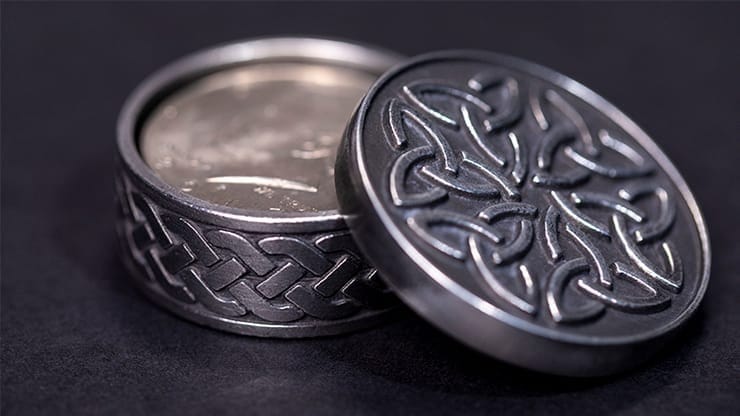
ProKito: From Pill Box to Pocket Miracle
Brian Watson - 22-Jul-2026
Category: About Vanishing Inc.
Brian shares the history of his ProKito boxes

Two Eds are Better Than One: Volume Five
Ed Hass - 14-Jul-2026
Category: About Vanishing Inc.
Ed shares his latest progress on Marlo's Magazines.


The Evolution of the Amazebox
Vanishing Inc. - 06-Jul-2026
Category: About Vanishing Inc.
When Mark Shortland showed us Amazebox, we knew we had something special...