Can You Really Feel Premium Cards?
By Alice Pailhès & Gustav Kuhn -
Walk into any magic convention and you will hear strong opinions about playing cards. “These ones feel the best”, “my faros are much cleaner with this deck”, “You can tell this is a premium deck.” Most magicians prefer certain cards over others, but are also often convinced that they can feel the difference.
This year at The Session, we decided to turn that intuition into a playful but informative challenge.
The MAGIC Lab at The Session
For three days, we ran a full MAGIC Lab at The Session, running fun, interactive experiments with magicians willing to participate. Alongside eye-tracking demonstrations, a one-minute creativity challenge, Pepper the mind-reading robot, and focus groups on the ethics of deception, we ran one deceptively simple experiment that quickly became a favourite for which people were queuing to participate: a blind test of card quality.
The Blind Box Challenge
Card companies often describe their decks as premium, and magicians often believe they can detect that quality instantly, even by touch alone. So we asked a very simple question:
Can magicians reliably tell different decks of cards apart by touch alone, when they can't see the card or know the brand?
To minimise expectation and brand effects, we kept the design deliberately minimal. We built a special box, which meant that participants could touch and manipulate our decks of cards, without seeing what they were handling. Like this, they only had access to tactile information. The order of the decks was randomised each time to avoid any order effect, and we asked participants to rate the decks in terms of quality on a scale from 1 to 10.
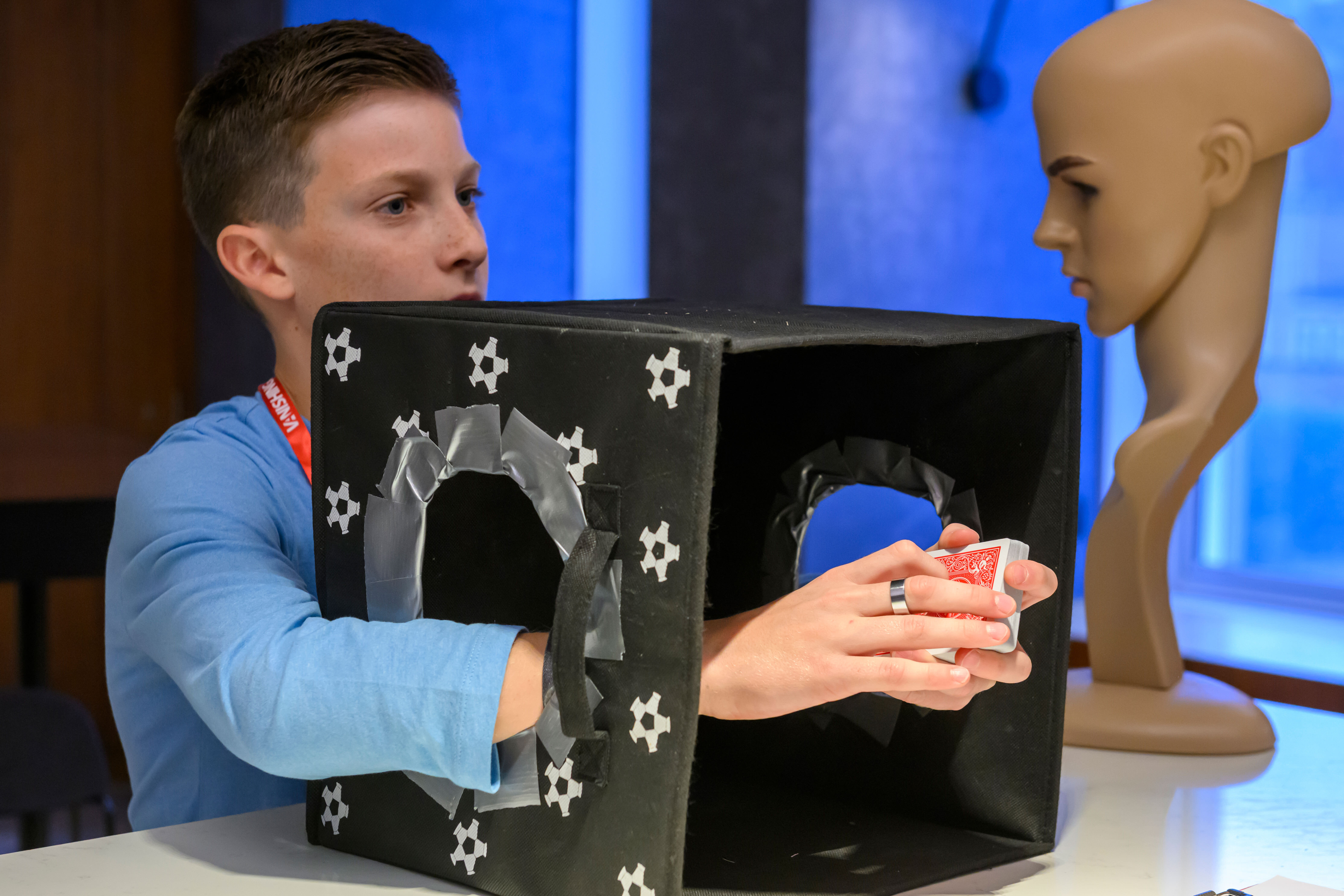
Before placing their hands in the box, almost everyone expressed confidence. Many felt sure they could identify which decks were “better,” “premium,” or simply the ones they usually use and like best… Then we collected the data.
The Four Decks We Tested
1. Bicycle Standard Playing Cards
These are the classic Rider Back cards almost every magician knows: simple, reliable, and extremely common. You can find them for around $3 to $4 per deck in many shops.
2. Bicycle Elite Edition Playing Cards (Blue) / Bicycle Elite Edition Playing Cards (Red)
These are an ultra-thin, “working pro” version of Bicycle cards, often praised for handling and flexibility, and usually priced around $5–$6 per deck.
3. Bicycle Gold Playing Cards
A deck often marketed with a more “premium” feel than standard Bicycle cards, typically around $8-$10 per deck depending on the seller.
4. Monarch Playing Cards
These are widely considered among the “premium” playing card lines, with elegant design, rich finish, and often positioned as collector’s or luxury decks, usually around $13 per deck depending on the version.
The Results
When we analysed the responses of our 50 participants at the end of the weekend, something striking appeared. Despite high confidence levels, participants’ judgments were no better than chance.
In other words, although many magicians thought they could tell the decks apart, under blind conditions, their tactile discrimination did not reliably support that belief. Many participants even though we were handing them the same deck over and over again.
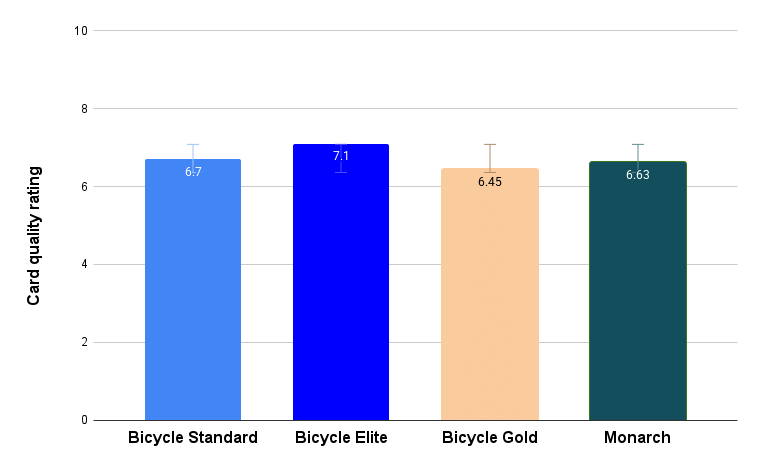
Now, let’s be very clear that these results do not mean that all playing cards are the same. It does not mean that card quality doesn’t matter, and it certainly does not mean that preferences are meaningless.
However, what it does suggest is something more specific, and even more interesting:
When visual and brand cues are removed, it becomes very difficult to reliably tell card quality apart by touch alone.
This experiment was designed as a pilot study — closer to a data-driven challenge than a full laboratory experiment. Its goal was not to settle the question once and for all, but to test a strong intuition in a controlled way and see what happened. And what happened opened up many new questions.
The Questions This Raises
Future studies could explore things we did not control for here, such as:
- The influence of which decks magicians usually work with
- How much they use cards in their performances
- Differences between close-up magicians, mentalists, and stage magicians
- Individual preferences for thickness, stiffness, finish, or handling style
- Whether familiarity with a specific deck improves tactile discrimination over time
In other words, there is a rich space for further investigation, and plenty of room for nuance.
A Psychological Takeaway
This experiment offers a very nice illustration of what we call in psychology overconfidence bias.
Overconfidence bias is our tendency to overestimate the accuracy of our judgments, especially in domains where we have experience and expertise. The more familiar we are with something, the more convincing our intuition feels… even when that intuition is wrong.
Sometimes expertise really does sharpen perception. But sometimes confidence comes from expectation, habit, and belief, rather than from detectable sensory differences.
When those expectations are stripped away, the gap between confidence and performance can become visible.
From Lab to Stage
The goal of the MAGIC Lab is not to replace experience with spreadsheets, but to keep our intuitions honest. Magic has evolved for centuries through observation, discussion, and shared experience. Science simply gives us another tool, one that helps us notice when belief, habit, and confidence subtly take the lead. And very often, it gives us a surprise…
Help us take this further for our next book!
We’re currently working on our second book for magicians. While The Psychology of Magic focused on explaining the psychological mechanisms that make deception possible, this new project shifts the focus toward experience — how magical moments are felt, remembered, and made meaningful by audiences.
To explore these questions properly, we need data from you, magicians.
We have a brand new (and short) survey for magicians, and we’d love your input:
If you’d like to take part in future MAGIC Lab experiments, you can sign up here:
Sign up for future experiments
As a thank-you, participants will have the chance to win an advance copy of the book.
If you’ve ever wondered why some moments of magic linger long after the trick is over, this is your chance to help us explore that together!
Reader comments

Tommy Gun
Interesting! I assume the cards were new? I wonder if there would be any difference if all decks had been shuffled for some amount of time. This reminds me of lots of other studies where people are overconfident in their abilities -- wine tasting, digital vs. analog film, etc.

To me the results are not a surprise. None of those decks is actually a bad deck of cards. Standards are actually decent decks of cards. I don't think the Monarchs are any better. They are just expensive because of fancy design and packaging. And all the decks are printed by USPCC. So the results should not be surprising. Now what would happen if you mixed in vastly different decks? Copags? Cheap cards from China? Cards from Shuffled Ink? What if you were able use completely blank cards so a tester could try to do a Faro shuffle? A Faro blindfolded is extremely difficult.
Leave a comment
to post a comment.
Similar posts on the blog


The Session 2023 Preview: Matt Baker
Vanishing Inc. - 24-Dec-2022
Category: The Session
Get to know Matt Baker ahead of his highly-anticipated European convention debut


The Session 2023 Preview: Markobi
Vanishing Inc. - 04-Dec-2022
Category: The Session
Get to know Markobi before he brings his one-of-a-kind card magic to The Session.


The Session 2023 Preview: Alex Romanoff
Vanishing Inc. - 20-Nov-2022
Category: The Session
Alex Romanoff explores how examining magic's past can help us better shape its future.


The Session 2023 Preview: Arthur Benjamin
Vanishing Inc. - 13-Nov-2022
Category: The Session
Dr. Arthur Benjamin is joining us at The Session to prove how magic and math can work together in exciting ways we never thought possible.