The History of the Linking Finger Rings
By Andi Gladwin -
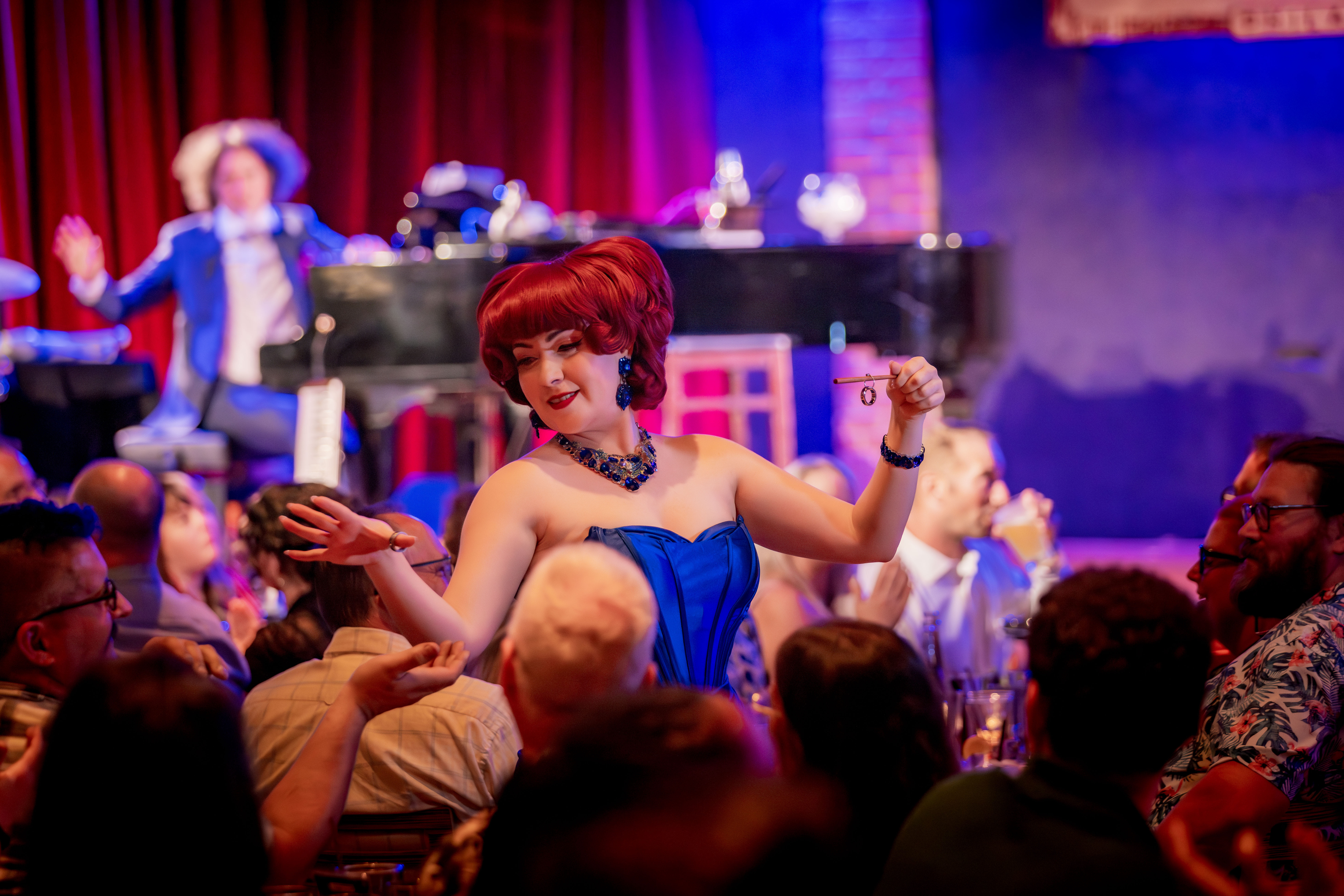 The linking of solid metal rings is one of magic’s oldest effects. Though the Linking Rings go back centuries as a stage classic, the smaller and more intimate Linking Finger Rings grew from that effect into a modern performance piece. In this version of the plot, large rings (props that were clearly purchased from a magic store) are replaced with borrowed finger rings, and, in my opinion, the plot becomes infinitely more memorable.
With the release of Carisa Hendrix’s “Nova Rings,” I thought it would be fun to dig into the history of the plot. Many of us have heard of the Himber Ring as a method, but the plot turns out to have quite a fascinating history.
Early Origins: 19th-Century Germany
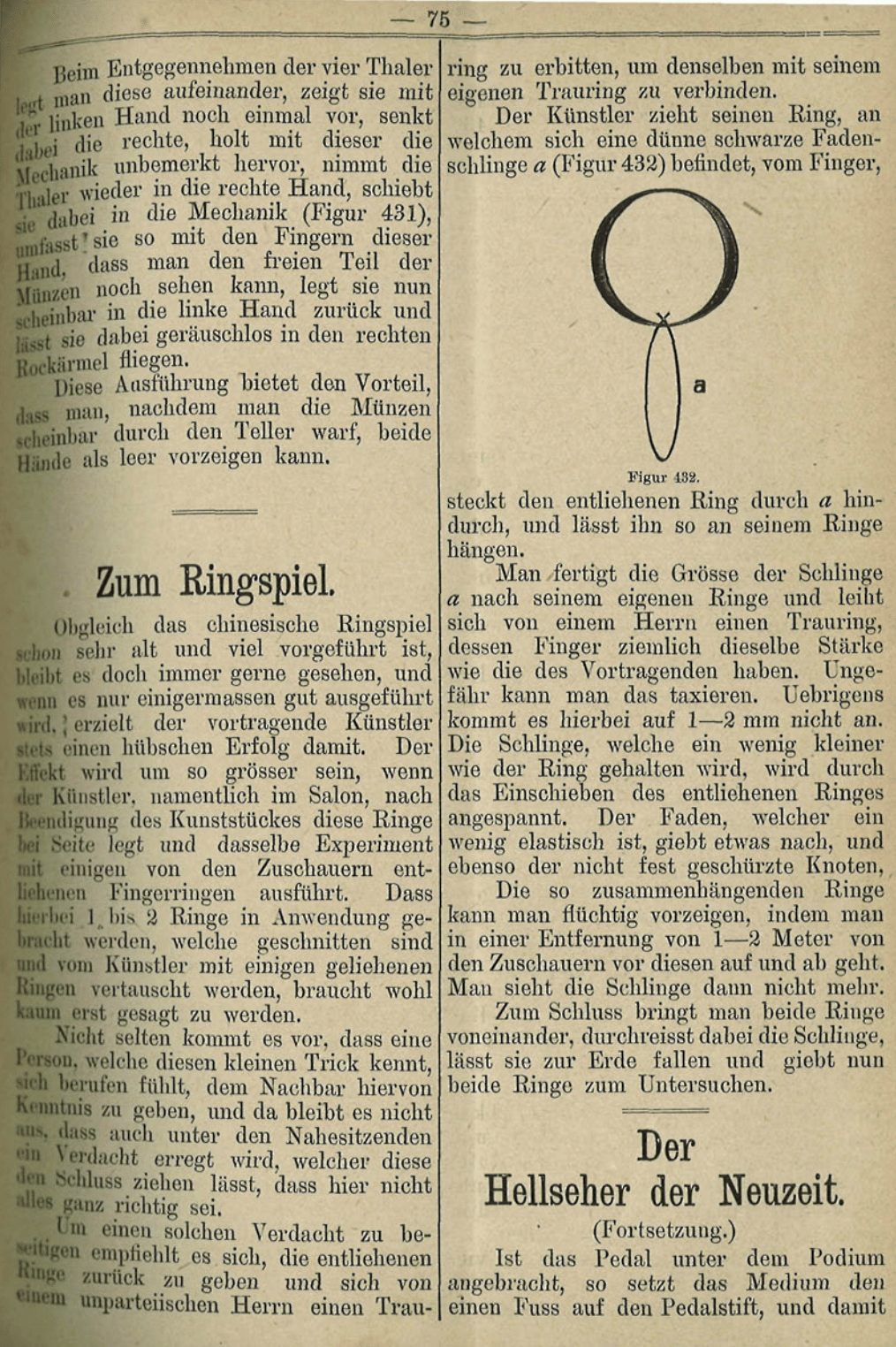 The first known description of linking borrowed finger rings appeared in Zauberwelt (May 1899), in a short article titled “Zum Ringspiel.” Likely authored by editor Carl Willmann, it suggested two methods. The first was a close-up version of the traditional Linking Rings, suggesting the use of slitted finger rings. The second, more detailed, used unprepared rings and a hidden thread loop to simulate a genuine link. That method is really quite smart, and I know others have played with it more recently.
In 1921, The Sphinx (Vol. 20 No. 10) described a routine by Glenn Gravatt and Harold McFaddan in which several borrowed finger rings were collected and “linked together into a chain or any design.” When a method was later requested, William Larson Jr. suggested secretly introducing “key rings” into the group. It’s hard to be sure, but it’s quite possible that this was the original creators’ own method. Either way, this established the basic method we still use today, which involves one or more sneakily prepared rings being disguised amongst real ones.
Devant’s Vision
While at the American Museum of Magic in Marshall, Michigan, Carisa discovered a clipping from The Strand newspaper, misfiled among miscellaneous papers, which they excitedly shared with me. In it, we learn a rare surviving trace of Devant’s unpublished inspirations. He described, in an article called “Tricks I Should Like to Do”:
“I want to borrow some rings—ordinary finger rings—from members of the audience and put them in a glass, take them out of the glass and show them all linked together. Then they are to be unlinked and returned to their owners.”
This idea, written decades before anyone could actually build such a gimmick, reveals Devant’s ambition to turn a big-stage piece into something personal, linking the audience’s own jewellery. The Strand article was eventually republished in The Linking Ring (Vol. 36 No. 6, August 1956).
The Himber Ring
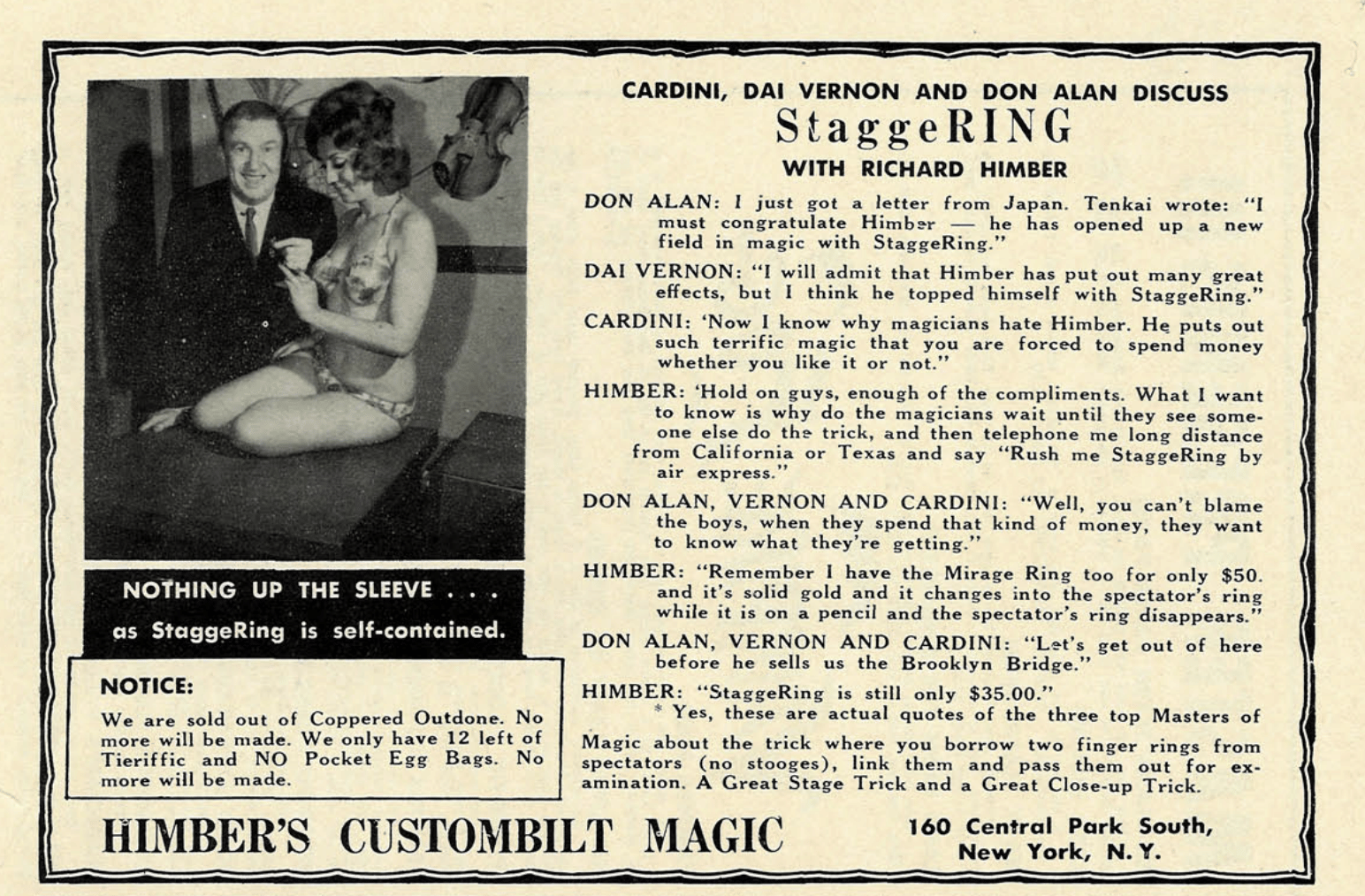 In more recent times, the more modern Linking Finger Rings began with Richard Himber, a magician whose marketed effect, “StaggeRING” (c. 1961), started a new generation of Linking Finger Rings. Advertised in Genii magazine with the claim that a notary public had witnessed the demonstration, it promised the linking of two borrowed rings on a pencil.
However, as Pete Biro later revealed, the ingenious mechanism was not Himber’s invention but that of Persi Diaconis, then a teenage prodigy and Protégé of Dai Vernon and Ed Marlo. Diaconis was inspired by Freddy Fah, a French magician who, as recorded by Harry Stanley in The Gen (April 1954), incorporated the linking of a spectator’s ring to a large stage ring during his Chinese Rings routine. Diaconis miniaturised that principle into what would become the Himber Ring, a precision-engineered, slotted band that could open and close invisibly. Rumour has it that the ring was not custom-manufactured, but instead a ring that was designed for people with arthritis. I haven’t been able to confirm that, though.
Shortly after, U. F. Grant introduced his own method in The New Tops (March 1963). His version involved a borrowed ring, apparently linking with the magician’s own ring, using a duplicate ring with a concealed slit. Grant advertised this effect in Genii the same year, promoting it as a “super sensational release” in which “you may offer a reward to anyone who can find your ring is gimmicked, as it is not gimmicked!”
From Himber to Porper
The Himber Ring became a professional standard, featured by performers such as Al Koran, Billy McComb, Nick Lewin, Richard Osterlind, and The Amazing Kreskin. McComb’s routine in McComb’s Magic: 25 Years Wiser demonstrated the trick’s theatrical potential.
Pete Biro, a close associate of both Himber and Diaconis, recognised flaws in the classic design: it required two hands and precise orientation. “One day,” he wrote, “I realised the ring design was wrong.” Working with Joe Porper, a master machinist, Biro re-engineered the mechanism into what became known as the “Ghostly Linking Finger Rings.” Their 2004 version could be opened one-handed, greatly simplifying the handling. The marketed kit included not only the improved ring but also an Al Koran–inspired mechanical pencil, used for the final illusion in which one ring visibly melts free and drops into a participant’s hand.
Even years later, the product was used in performance by Lu Chen, who called it his “favourite trick” while receiving Magician of the Year honours from the Academy of Magical Arts. For many, it became the standard gimmick for this plot.
Carisa Hendrix’s Story … the Nova Rings
 Carisa’s personal history of this plot begins with a purchase at Tannen's Magic, where a discounted Ghostly Fingers Ring was on sale. They hadn’t seen such a ring before, but they knew that one day they’d find a use for it.
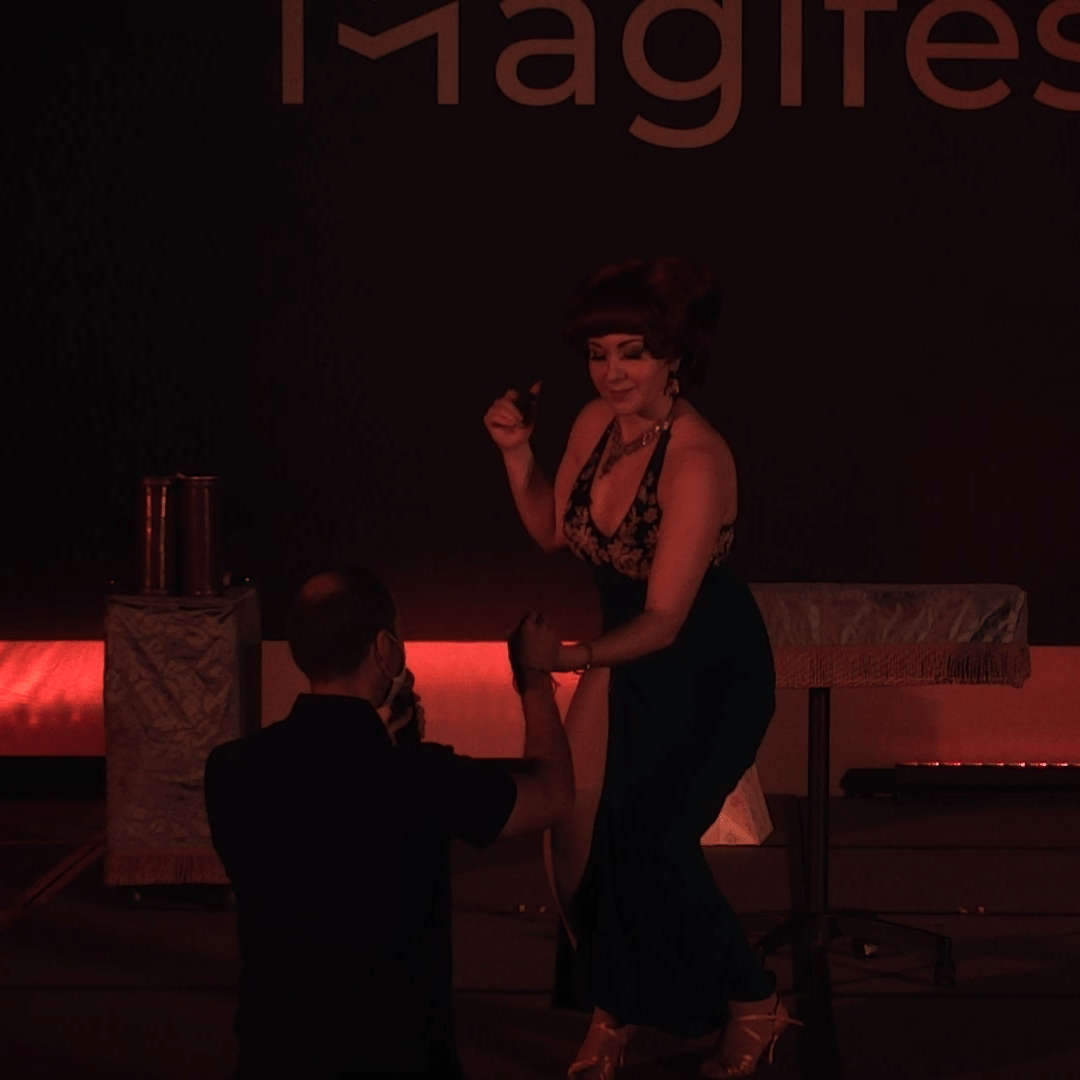
The most important part of the routine was the presentation. If you have ever seen Carisa’s alter-ego, Lucy Darling, you’ll know that she doesn’t just do a quick trick or two. Lucy’s presentations are elaborate pieces, designed to connect with the audience. Actually, Lucy is there to be entertained by the audience, so in her initial version, she had three people propose to her on stage and then link all their rings. It was one of the most talked-about performances at Magifest 2021 (the one where we all wore masks), and I enjoyed it because it featured Jeff Kowalk, our now CFO, giving a heartfelt proposal to Lucy!
Over time, Carisa became unsatisfied with the Porper ring. Despite how it was advertised, the ring didn’t lock closed, and because it only opened one way, the unlink wasn’t as smooth as it should have been. Carisa developed a handling that fixed some of the issues, but soon realised that the problem wasn’t the handling, but actually one of manufacturing. So, working with Vanishing Inc. and with full permission from the Joe Porper estate, Carisa spent several years tweaking the design to address all the problems they discovered.
With our new version, the rings can swing in both directions, they magnetically hold closed, and, most importantly, they are designed to look exactly like the rings you’ll find in your audience. You also get three different colour rings: three duplicate rings and a holder that makes the routine, all for half the price Carisa paid for an original set! The ring's new quality allowed Carisa to adapt their presentation to something less elaborate. Now, when Lucy performs the routine, she stands directly in front of a camera and links the audience’s rings, with the camera zoomed in on her hands. It never fails to be a standout moment of the show.
Leave a comment
to post a comment.
Similar posts on the blog

Two Eds are Better Than One: Volume Six
Ed Hass - 19-Aug-2026
Category: About Vanishing Inc.
Ed shares more progress on Marlo's Magazines.

ProKito: From Pill Box to Pocket Miracle
Brian Watson - 22-Jul-2026
Category: About Vanishing Inc.
Brian shares the history of his ProKito boxes

Two Eds are Better Than One: Volume Five
Ed Hass - 14-Jul-2026
Category: About Vanishing Inc.
Ed shares his latest progress on Marlo's Magazines.

The Evolution of the Amazebox
Vanishing Inc. - 06-Jul-2026
Category: About Vanishing Inc.
When Mark Shortland showed us Amazebox, we knew we had something special...